Retro, rebooted: five new-age categories, five retro campaigns, and a vote
The old ads in our Time Machine series worked because they were simple, human and local. New-age brands have the same needs and a different look. We drew the idea; you tell us whose it is.
Retro, rebooted is a series of five campaign concepts that take a vintage Indian advertising idea and redraw it for today, one each for an EV maker, a payments app, an investing app, a quick-commerce app and a food delivery app. We name no client. We ask people to tag the brand they think should run each, and we publish the tally. Our own Share of Search Index supplies the category data.
This is part of #ColleviateTimeMachine. The artwork in this series is original and shows fictional brands. We have not redrawn any real campaign, mascot or slogan, and no national symbol appears. The five pieces below are different: they are drawn for today, in a clean contemporary style, for categories of company. No real logo, mascot, pack or app screen appears. Brands are named in the captions only.
How the vote works
Each concept is posted on Instagram and LinkedIn with one question: which brand should run this? Tag them. We count the tags for each concept and publish the tally here, and we'll update this page. If a brand wants to talk, it can write to us, and a real version would be developed with that brand, not for it.
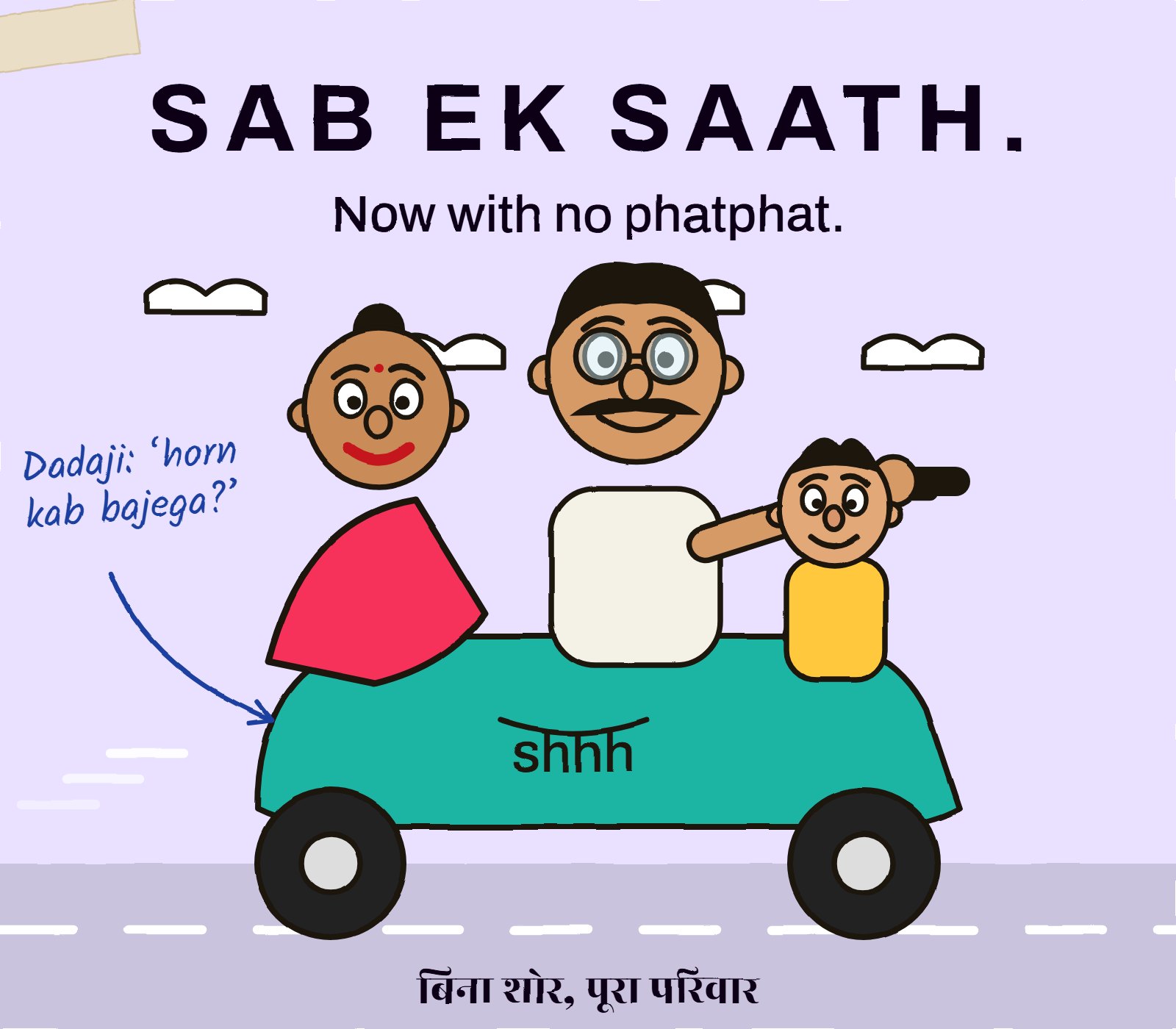
1. An EV maker: “Sab ek saath. Now with no phatphat.”
The retro idiom is the 1970s family scooter, the most recognisable image on an Indian road. The idea keeps the whole family on one vehicle and takes away the noise, so silence becomes the thing the household shares. The data: in our index of electric two-wheeler search, Ather holds 62.2 percent of branded search, ahead of Ola Electric (14.7), TVS iQube (13.5) and Bajaj Chetak (9.5), and has led every month since September 2025. See the electric two-wheeler deep-dive.
2. A payments app: “Khata closed. Scan open.”
The retro idiom is the kirana shop's credit ledger. The idea sets the closed ledger beside a QR board in the same uncle's hand. It speaks to the shop, not the shopper. The data: in UPI app search, PhonePe holds 37.0 percent and Paytm 35.6, with Google Pay at 21.5 and CRED at 5.9, and PhonePe has led since May 2026, per the UPI deep-dive. A close race is where an idea like this earns its keep.
3. An investing app: “Start small. Stay long.”
The retro idiom is the bank passbook and the coin jar. The idea makes beginning feel ordinary, with an uncle, a passbook and a plant in a jar. The data: Groww holds 40.1 percent of stockbroking search, ahead of Zerodha (30.2) and Angel One (21.2), per the stockbroking deep-dive. A real campaign would need to follow the regulator's rules for investment advertising, and nothing here is advice.
4. A quick-commerce app: “Faster than your chai.”
The retro idiom is the neighbourhood kirana that knows your order. The idea puts a ten-minute stopwatch beside a cup of chai and the same uncle with a bag. The data: Blinkit holds 56.4 percent of quick-commerce search, Zepto 28.0, Swiggy Instamart 10.7 and BigBasket 4.9, per the quick-commerce deep-dive.
5. A food delivery app: “Amma packed it. Maps tracked it.”
The retro idiom is the home tiffin. The idea sets a mother packing a tiffin beside a phone with a live route. The data: Swiggy holds 50.9 percent and Zomato 49.1 of company-brand search, and the lead has changed hands repeatedly, per the food delivery deep-dive. It is the closest race in the index, and the one where a warm idea could matter most.
What the data does and doesn't say
Share of search measures attention, not sales, and it is a reading of a brand name against its named rivals. It doesn't tell a brand what to say. It tells us which of these categories is a close race, which is a settled one, and so what kind of idea each might want. How to read a number like this is in what is a good share of search.
How we would test any of them
Before spending a rupee, we would run each concept against one question: does it make the brand more likely to be searched for by name? We'd measure that before and after, against the same competitors, with the margin of error shown, as in how to measure share of search. The reading method behind the format is in how to read a vintage ad, and the history is in the series hub, iconic Indian ads for the ages.
The open door
If you work at one of these brands and this is useful, or wrong, we'd like to hear it: colleviate.com/contact.
Sources
- Colleviate Share of Search Index, India, Colleviate, October 2026
Questions we get asked
What is Retro, rebooted?
A series of five campaign concepts that redraw a vintage Indian advertising idea for today, one each for an EV maker, a payments app, an investing app, a quick-commerce app and a food delivery app.
Do the brands know about this?
No. These are original concepts and no brand has seen them. A tag is a suggestion from the public.
Where does the data come from?
From the Colleviate Share of Search Index for India, which uses Google Trends. It measures attention, not sales.
Tell us the brand and the thing that isn't working
We will come back with a point of view, not a credentials deck. If we are not the right fit, we will say so.
Ask for a scoped auditWhat we do · How we produce it · Who we do it for · Talk to us