When the sponsor joined the story: Hum Log and Doordarshan
A single channel, a single national audience and a brand that paid to sit beside the story. The 1980s were the decade advertising got a seat in the living room.
Hum Log began on Doordarshan on 7 July 1984 and is widely reported as the first Indian show to carry sponsorship, with Nestle among the sponsors. It marks the point where advertising stopped being an interval between programmes and became part of how a programme was made and paid for.
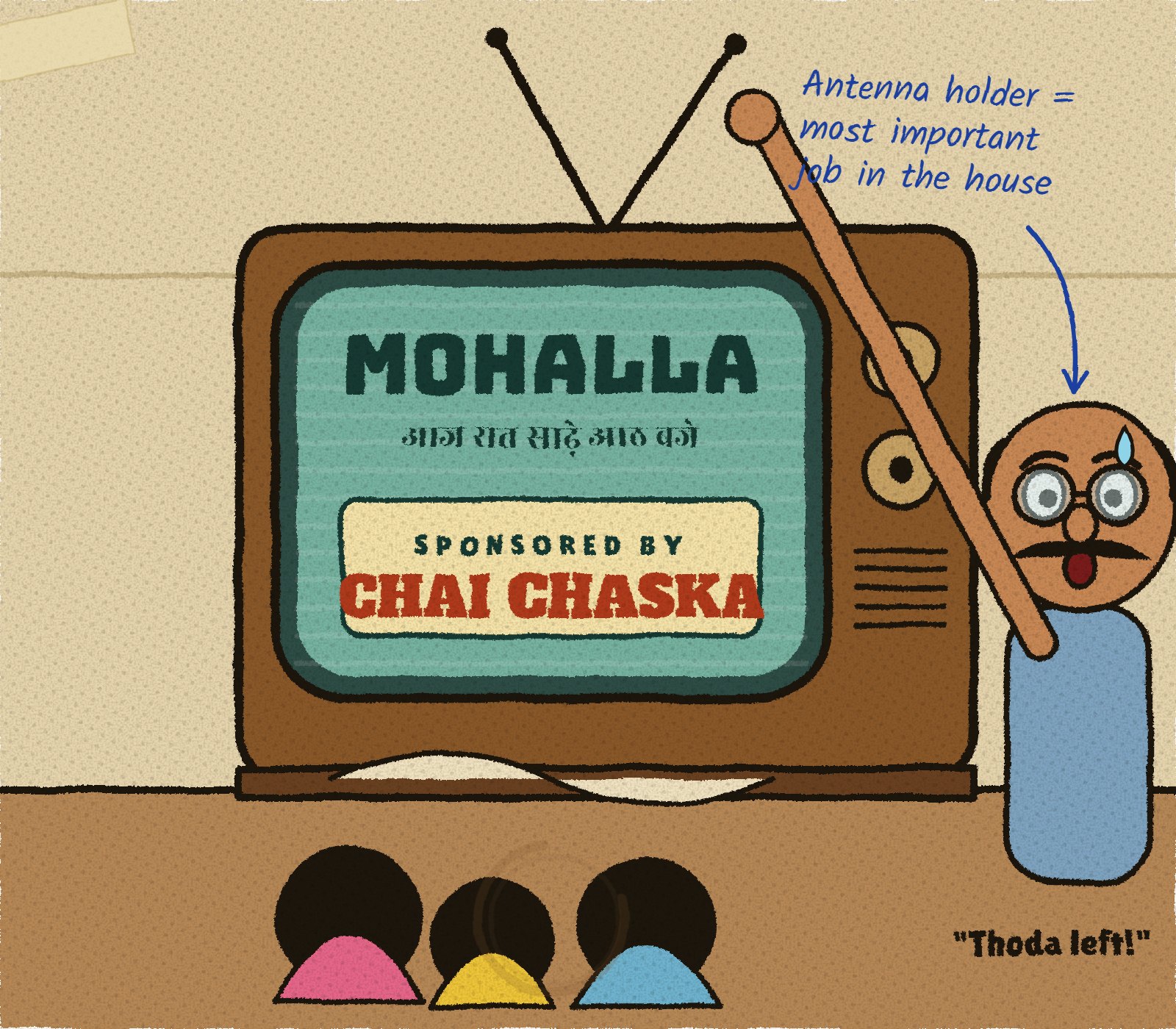
The artwork in this series is original and shows fictional brands. We have not redrawn any real campaign, mascot or slogan, and no national symbol appears. The 1980s piece beside this essay is a fictional sponsored serial card.
What the record says
Doordarshan began carrying commercials in the 1970s, with sources giving 1976 or 1977. Colour arrived in August 1982, around the Asian Games in Delhi, and the Games drove a wave of set purchases. Hum Log, a family serial, began on 7 July 1984 and is widely reported as the first Indian show to carry sponsorship. A Nestle advertising executive, interviewed by Storyboard18, recalled that sponsored programmes did not exist at the time, that the company took up the sponsorship after the producer approached it, and that the sponsor's advertising time after each episode ran to about 40 seconds. Nestle's Maggi launch film had already run on Doordarshan in 1983.
Two cautions. The “first sponsored show” claim rests mainly on a Nestle recollection and encyclopaedia entries, and sources disagree on when sponsored programmes became routine (1984 or 1987). And the serial itself was reportedly not well preserved, so there is little left to watch.
A sponsor is not an interval
Before sponsorship, an advertiser bought time between things. After it, an advertiser bought a relationship with a thing. A family serial watched by a household at a fixed hour gave a brand the same slot every week, and the audience came to associate the two. The product became a regular guest, the sort who turns up every Tuesday at the same time and is somehow always fed.
What the scholarship adds
Purnima Mankekar's Screening Culture, Viewing Politics is an ethnography of how women viewers in Delhi received Doordarshan serials of the 1980s and early 1990s. Its argument, as its publisher and reviewers describe it, is that television helped build ideas of nation and womanhood, and that the state invested in an image of the woman to define the nation. It is a study of the serials, not of the advertising around them, and we are extending it, not quoting it.
Our extension is this. If the serial taught a household what a good family looked like, the sponsor was the voice that told it what to buy to be one. Raymond Williams's point that advertising obscures the choices behind goods has a sharp edge here, because the story's authority passed to the product.
What it means now
Every branded series, creator partnership and podcast is a descendant of this arrangement. The question is the old one: is the brand a guest in the story, or has it taken over the telling? Our view is the first, as what a campaign owes the culture it borrows from argues, and as a brand launch plan should say in writing.
Sources
- How Nestle sponsored Hum Log and changed the TV advertising landscape in India, Storyboard18, undated
- 1982 Asian Games: how sports brought colours to Indian television, The Bridge, undated
- Doordarshan, Wikipedia, undated
- Screening Culture, Viewing Politics: An Ethnography of Television, Womanhood, and Nation in Postcolonial India (Purnima Mankekar), Duke University Press, 1999
- Advertising: The Magic System (Raymond Williams), New Left Review, 1960
Questions we get asked
Was Hum Log the first sponsored show in India?
It is widely reported as such, with Nestle among its sponsors, on the evidence of a Nestle executive's recollection and reference entries. Sources differ on when sponsored programmes became routine.
When did Doordarshan start carrying ads?
In the 1970s; sources give 1976 or 1977.
What did Mankekar study?
Her 1999 book is an ethnography of how women viewers in Delhi received Doordarshan serials of the 1980s and early 1990s, and how television helped build ideas of nation and womanhood. It does not study the ads.
Place your brand inside a story
We help brands decide when to sponsor, when to produce and when to stay out of someone else's story.
Ask for a scoped auditWhat we do · How we produce it · Who we do it for · Talk to us