From Hamara Bajaj to the electric scooter: what a family vehicle used to promise
The scooter ad that people still hum was not about the scooter. It was about the people on it.
The Hamara Bajaj campaign for the Bajaj Chetak scooter is dated to 1989 and is reported as created by the agency Lintas. In our Share of Search Index, Ather holds 62.2 percent of electric two-wheeler search. The concept we would draw is a family on one scooter, with silence as the thing they share.
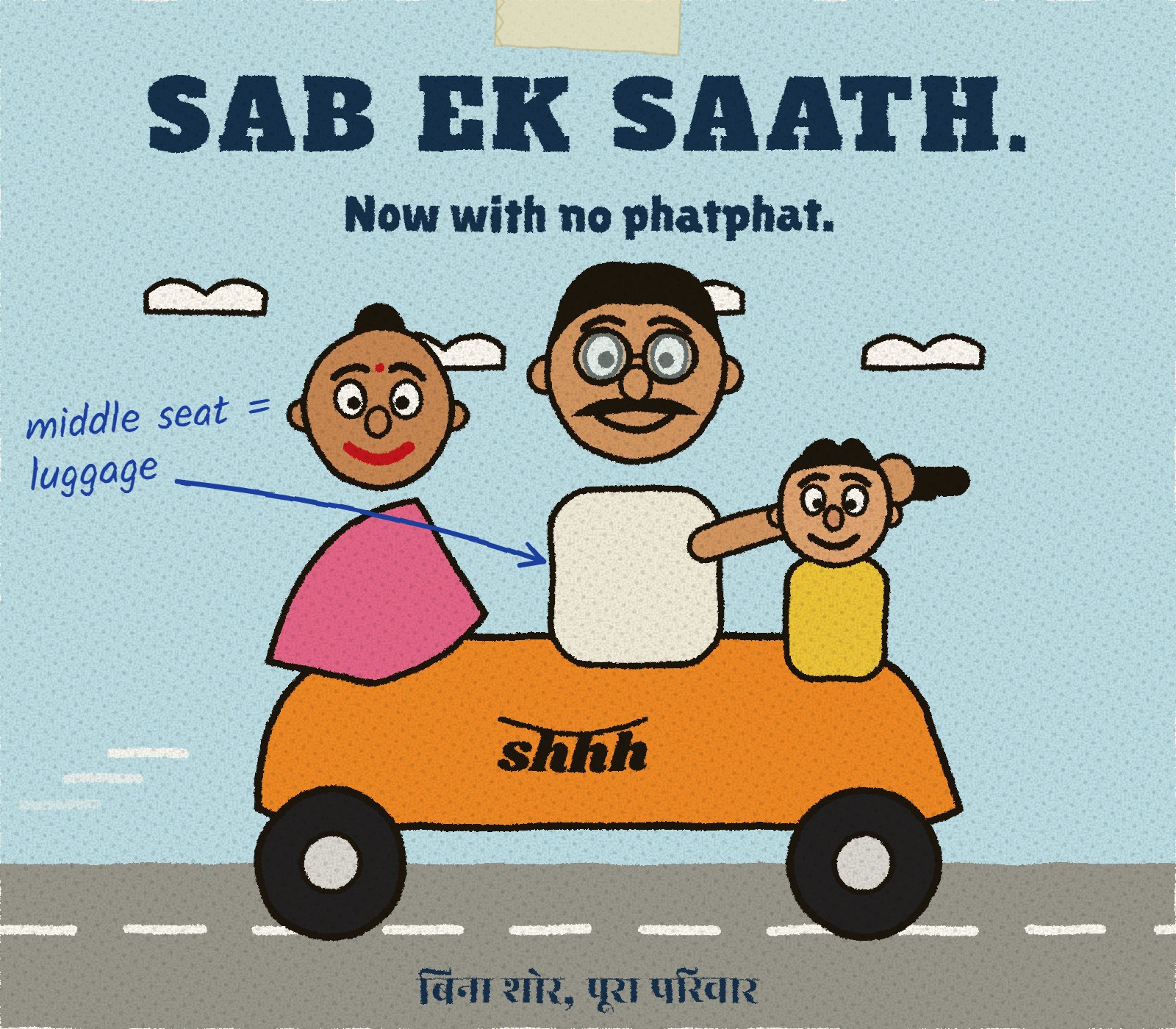
The artwork in this series is original and shows fictional brands. We have not redrawn any real campaign, mascot or slogan, and no national symbol appears. The family on the page is ours, on an orange scooter that is nobody's.
What the record says
The Hamara Bajaj campaign is dated to 1989 and is associated with the Bajaj Chetak scooter. It is reported as the work of the agency Lintas, and trade press credits particular people on the creative side. We haven't verified individual credits, so we do not name anyone here. What is not in dispute is how long the line lasted in memory. It said “ours”, and a whole country knew who was meant.
What it was selling
It was not selling a scooter's specification. It was selling belonging: the sense that this was the vehicle of a certain kind of household, the one that goes to the same relatives and the same market. That is a stronger claim than speed, and it explains why the memory outlasted the product's place in the market. It is also the point at which nostalgia becomes a trap, which we take up in nostalgia is not a strategy.
The category today
In our electric two-wheeler deep-dive, Ather holds 62.2 percent of branded search, ahead of Ola Electric at 14.7, TVS iQube at 13.5 and Bajaj Chetak at 9.5. Share of search measures attention, not sales. A clear lead is a different problem from a close race: the job is to keep what you hold and make it mean something.
The idea we would draw
“Now with no phatphat.” A family of four on one scooter, riding in silence, with “shhh” on its side. The handwritten note on the card says what every family knows, which is that whoever sits in the middle is the luggage. The old promise was belonging. The new one is that the household gets to share quiet.
What it asks of a brand
- Sell the household, not the specification.
- Make the new feature (here, silence) the thing the family shares.
- Be funny about the real inconvenience. The luggage joke is why the card works.
If you know someone at Ather, tag them on the post. More concepts are on the Window shopping page.
Sources
- Hamara Bajaj, Wikipedia, undated
- Bajaj Chetak, Wikipedia, undated
- Colleviate Share of Search Index, India, Colleviate, October 2026
Questions we get asked
When did Hamara Bajaj begin?
It is dated to 1989 and is associated with the Bajaj Chetak scooter.
What share of electric two-wheeler search does Ather hold?
In the Colleviate Share of Search Index, 62.2 percent, ahead of Ola Electric at 14.7, TVS iQube at 13.5 and Bajaj Chetak at 9.5.
Is this an Ather campaign?
No. It is a concept drawn by Colleviate for the Window shopping series.
Sell the household
We find what your customer shares with the people around them, and build the idea around it.
Ask for a scoped auditWhat we do · How we produce it · Who we do it for · Talk to us