One tune, many voices: Mile Sur Mera Tumhara and the state as advertiser
A film in the form of a commercial, broadcast to a nation, with no product in it. It is the most remembered piece of Indian advertising craft that sold nothing.
Mile Sur Mera Tumhara was first aired on Doordarshan on 15 August 1988, after the Prime Minister's Independence Day speech, developed by Lok Seva Sanchar Parishad as a national integration message. Credits for the song and the lyrics differ between sources. It used the grammar of advertising, repetition, a tune and a face, to sell an idea.
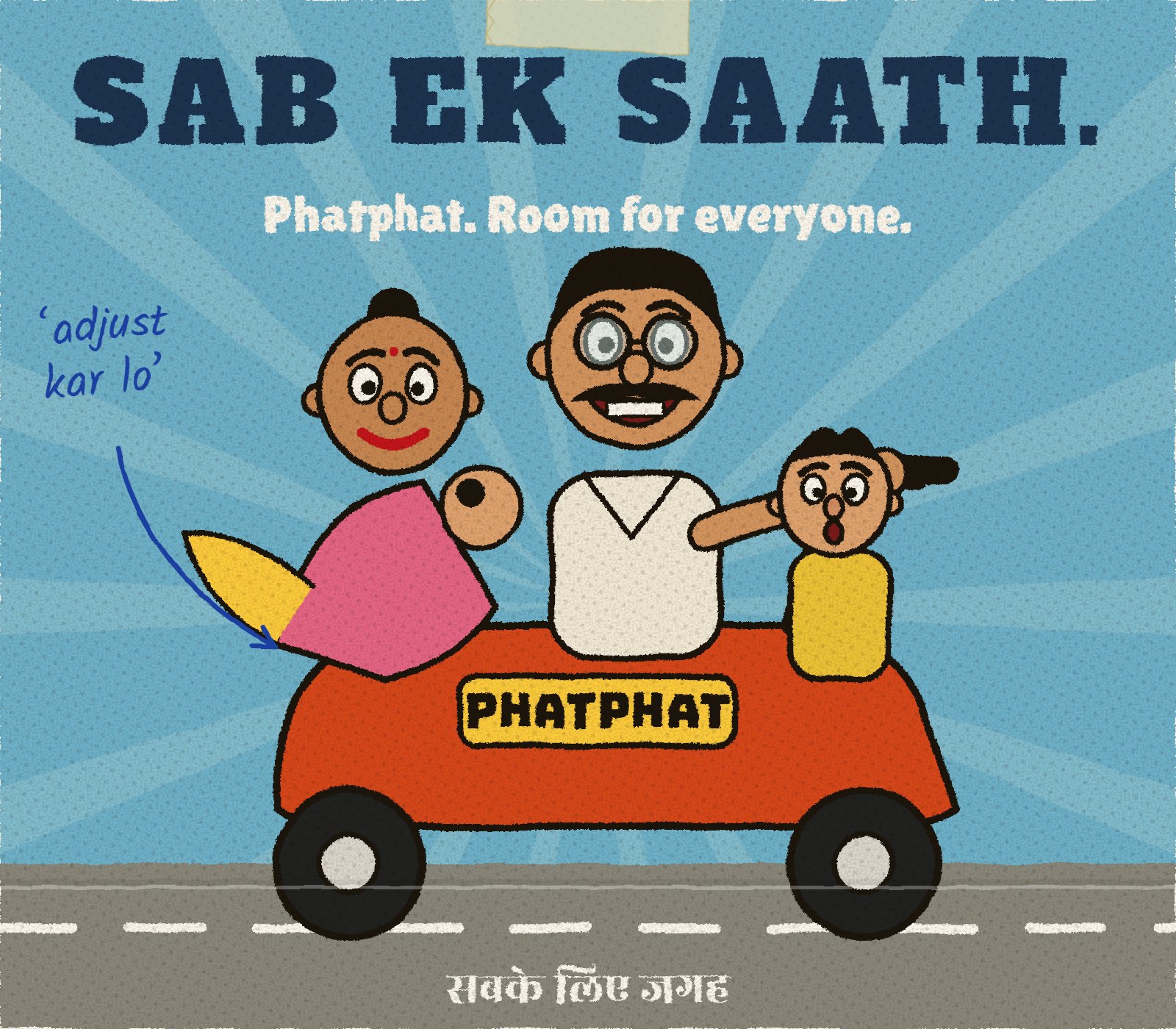
The artwork in this series is original and shows fictional brands. We have not redrawn any real campaign, mascot or slogan, and no national symbol appears. The piece beside this essay is a fictional 1970s family-scooter advertisement, chosen because its idea, everyone together, is the one this film carries.
What the record says
The film was developed in 1988 by Lok Seva Sanchar Parishad and promoted by Doordarshan and the Ministry of Information. It was first aired on 15 August 1988, after the telecast of the Prime Minister's speech from the Red Fort. Credits are contested. Suresh Mullick is widely credited with conceiving the song, and some sources credit Piyush Pandey with the lyrics and Kailash Surendranath with direction, while sources disagree on the composer. A 2025 report on a later attempt to remake it concluded the original was hard to repeat. We don't resolve the credits here, and because they differ, we won't name the lyricist or composer as fact.
What it borrowed from advertising
Repetition. A refrain that returns in every language. A parade of faces that makes the argument by accumulation: if enough different people sing the same line, the line is true. These are the techniques of a commercial, applied to an abstraction. The state borrowed the market's grammar to sell an idea no market could, which is a compliment to the grammar.
The culture industry reading
Adorno and Horkheimer would see a standardised form carrying a manufactured sameness. We think that is only half right. The film's form is standard, but its content is plurality: many languages, many places, one melody. The uniformity is in the structure, and the variety is in the surface, which is the reverse of the pseudo-individuality they described.
Purnima Mankekar's work on 1980s Doordarshan, as publishers and reviewers describe it, is about how television helped build a national identity that sat uneasily with the differences among its viewers. This film is the most optimistic version of that project. Reading it as advertising, not just as anthem, shows how much of nation-building was a craft problem: how do you make a million different people feel they are in one picture?
What it means for brands
Brands that claim to speak to all of India have a harder version of the same problem. The honest ones do what the film did: they put the differences on screen and find the line that holds them. The dishonest ones translate one ad into twelve languages and call it inclusive. For the practical side, see regional language marketing in India and what a campaign owes the culture it borrows from.
Sources
- Ogilvy celebrates two decades of 'Mile Sur Mera Tumhara', exchange4media, undated
- Mile Sur Mera Tumhara, Wikipedia, undated
- The Culture Industry: Enlightenment as Mass Deception (Adorno and Horkheimer), Marxists Internet Archive, 1944 text
- Screening Culture, Viewing Politics: An Ethnography of Television, Womanhood, and Nation in Postcolonial India (Purnima Mankekar), Duke University Press, 1999
Questions we get asked
When was Mile Sur Mera Tumhara first broadcast?
On 15 August 1988 on Doordarshan, after the Prime Minister's Independence Day speech.
Who made it?
It was developed by Lok Seva Sanchar Parishad and promoted by Doordarshan and the Ministry of Information. Credits for the song, lyrics and direction differ between sources.
Why read it as advertising?
Because it used the grammar of a commercial, repetition, a refrain and a parade of faces, to carry an idea of national unity rather than a product.
Speak to many Indias at once
We build multilingual campaigns where the differences are on screen and the idea holds across them.
Ask for a scoped auditWhat we do · How we produce it · Who we do it for · Talk to us