The price of a jingle: Nirma and the market nobody served
Most advertising of the 1970s spoke to households that could already afford the brand. One speaking to households that couldn't found a very large audience.
Nirma began in 1969 when Karsanbhai Patel started making a detergent in Ahmedabad and priced it at a fraction of the market leader. Reported accounts say it went on to take a large share of India's detergent market and forced Hindustan Lever into a new product. The lesson is about price and address: whom an ad is for.
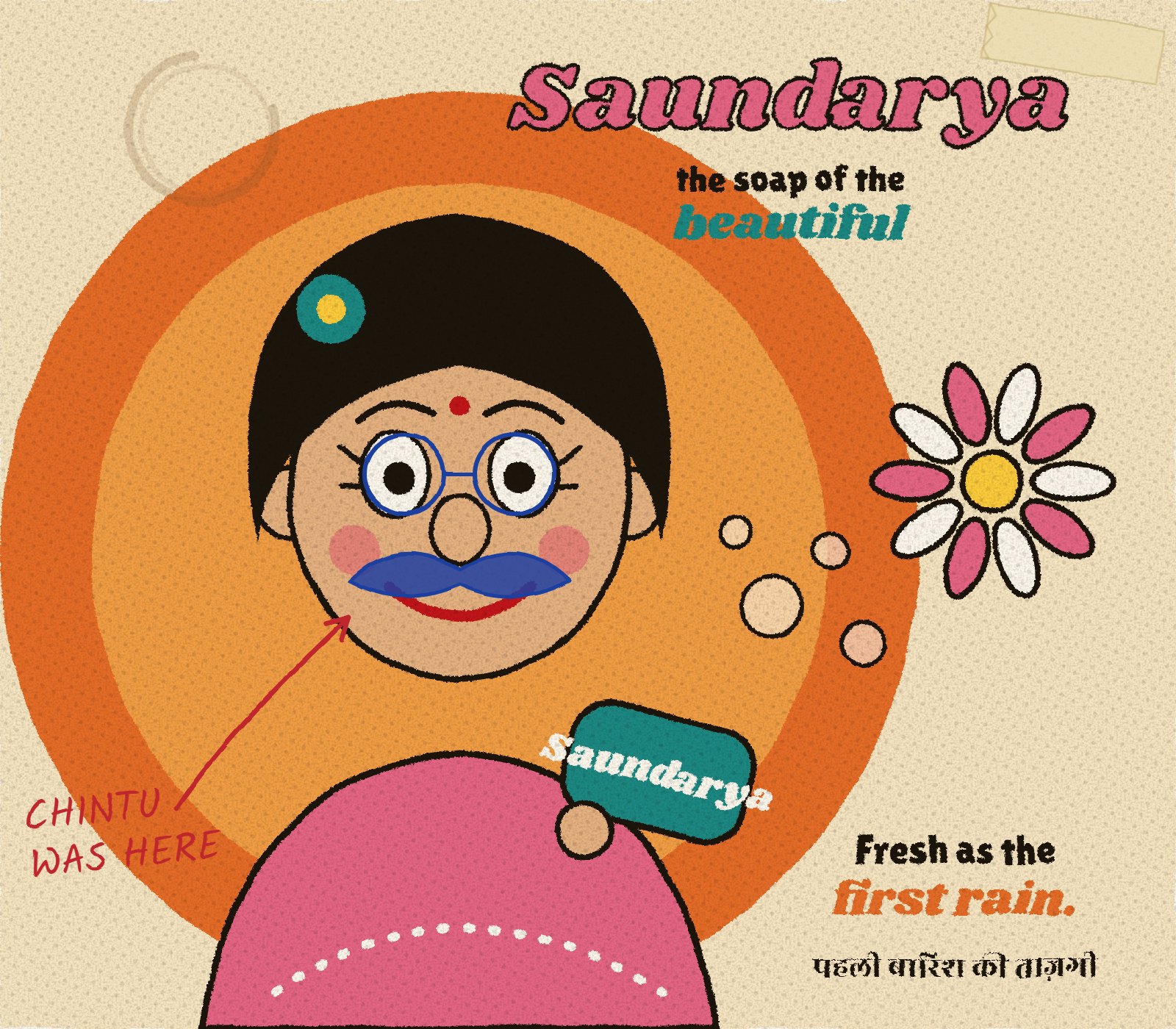
The artwork in this series is original and shows fictional brands. We have not redrawn any real campaign, mascot or slogan, and no national symbol appears. The piece beside this essay is a 1970s-style soap advertisement for a fictional brand.
What the accounts report
Karsanbhai Patel, a laboratory technician in Ahmedabad, began making a phosphate-free detergent in 1969 in a room at his home and sold it door to door. Accounts put his launch price at about Rs 3 to 3.5 a kilo, against about Rs 13 to 15 for the leading brand, Surf. They agree that it grew very quickly, and several say it reached about 60 percent of the detergent market by 1988, a figure that appears without a clear primary source, so treat it as reported. Hindustan Lever's answer is reported to have been the Wheel detergent in 1988, in an effort internally named Operation STING. A fuller account is a case study by Ghoshal and Butler, which we have not read.
A widely repeated anecdote that Hindustan Lever's research had spotted the opportunity and ignored it is, in the source we found, a hypothesis and not a documented fact. We leave it out.
Who an ad is for
Advertising of the period, as the culture industry critics would have predicted, tended to address a household already in the market: a woman choosing between brands of similar standing. Nirma's price addressed a different household, one for whom the choice was between a detergent and a bar of soap. The brand's real innovation was its audience, and nobody had put it in a brief. The advertising's job was to make a cheap thing feel like a chosen thing, which is where a memorable jingle and a repeated slogan did the work a premium pack couldn't.
Standardisation, from below
Adorno and Horkheimer worried that mass culture flattened differences. The Nirma story shows a mass product being used the other way: it widened who could take part in the market for a branded good. William Mazzarella's study of the Bombay advertising industry in the 1980s and 1990s is, as its publisher describes it, about how advertising mediated mass consumerism and national identity. We read Nirma as an early case of that mediation reaching further down the income ladder than the agencies of the time usually aimed. That is our reading, not his.
What it means now
If your price is your idea, the ad should say so plainly and often. If your category has ignored a segment, the creative problem is the segment, not the category. And a larger rival's reaction takes years, which is how a small brand gets its head start. For the economics, see the brand and performance split, and for how a price ought to be explained, what a marketing agency should cost.
Sources
- How a brilliant Gujarati created 'Sabki Pasand Nirma' in his backyard, The Better India, undated
- Roots to legacy: why is 'Sabki Pasand Nirma', Impact, undated
- The Culture Industry: Enlightenment as Mass Deception (Adorno and Horkheimer), Marxists Internet Archive, 1944 text
- Shoveling Smoke: Advertising and Globalization in Contemporary India (William Mazzarella), Duke University Press, 2003
Questions we get asked
When did Nirma start?
In 1969, when Karsanbhai Patel began making a phosphate-free detergent in Ahmedabad.
How cheap was it?
Accounts vary, but put its launch price at roughly Rs 3 to 3.5 a kilo against about Rs 13 to 15 for the leading brand.
What was Hindustan Lever's response?
Reported accounts say it launched Wheel in 1988 as part of an effort called Operation STING. A Ghoshal and Butler case study is the more rigorous source; we have not read it.
Find the audience nobody addressed
We map who your category advertises to and who it ignores, then build the price and the line that serve them.
Ask for a scoped auditWhat we do · How we produce it · Who we do it for · Talk to us