The hoarding that answered back: Amul and the topical ad
Most advertising asks for attention. This campaign earned it by commenting on the day, which is a different and harder thing.
Amul's hoarding campaign began in 1966, created by Sylvester daCunha's agency ASP, and became known for topical ads that comment on current events beside the butter. It is widely reported as the longest-running advertising campaign in the world. Read through the culture industry critics, it is advertising that shows its working.
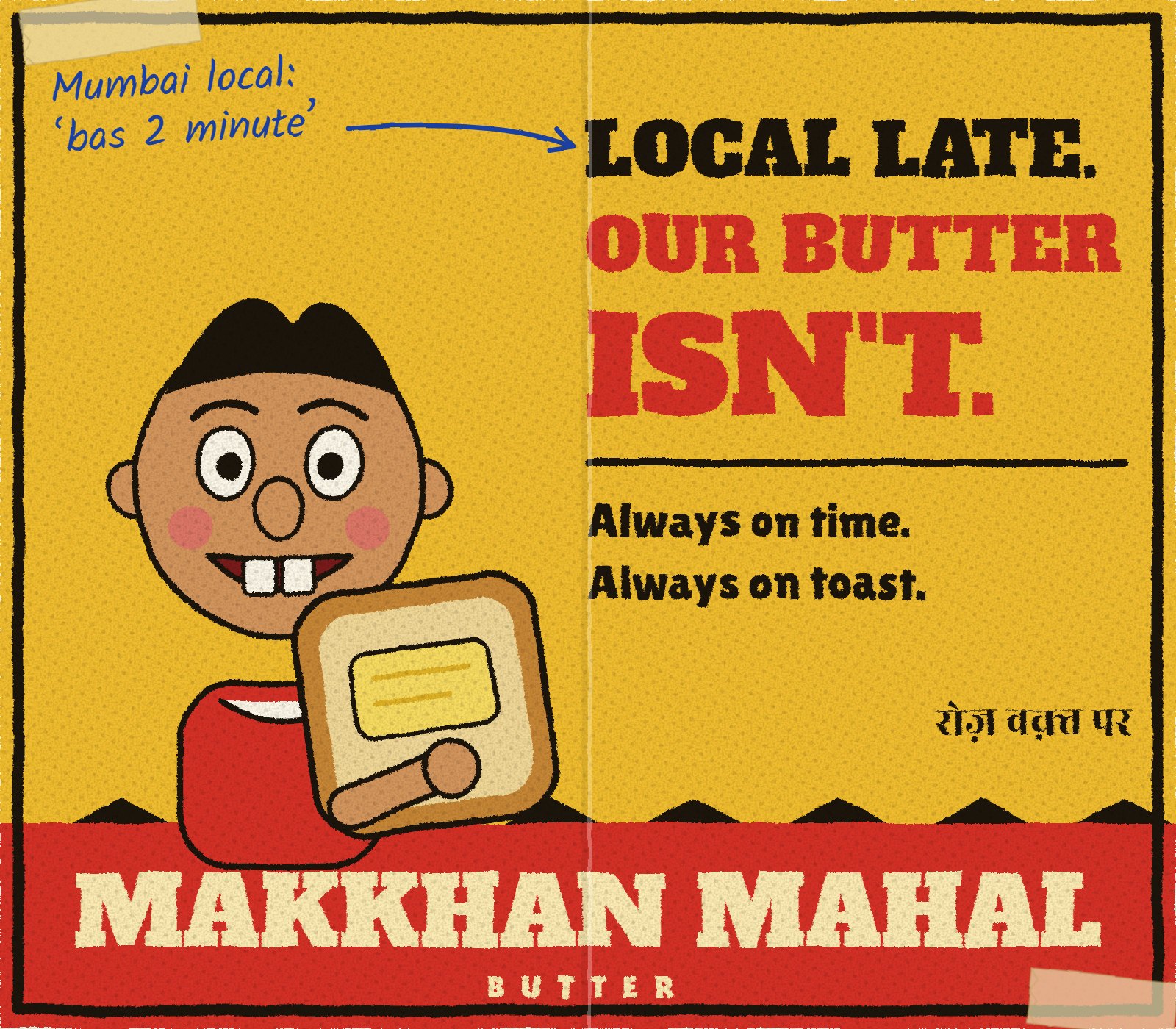
The artwork in this series is original and shows fictional brands. We have not redrawn any real campaign, mascot or slogan, and no national symbol appears. The piece beside this essay is a 1960s-style hoarding for a fictional butter.
What happened in 1966
According to the brand's own account and trade-press retellings, Sylvester daCunha's agency, ASP, won the Amul butter account in 1966. Television and print were costly, so the agency chose outdoor hoardings. The art director, Eustace Fernandes, and daCunha built a mascot meant to appeal to mothers and children. The first topical hoarding, reported as “Thoroughbread”, showed her as a jockey in the racing season. The tagline is credited to the daCunha family, with Nisha daCunha's “Utterly Amul” extended by Sylvester to the form we know. Sources disagree on whether the first hoarding appeared in 1966 or 1967, and on exactly how the account reached the agency, so we say “1966” because most of them do.
The campaign is described by the brand and in the press as the longest-running advertising campaign in the world, and as holding a Guinness record. We haven't seen the record's own listing, so we pass that on as reported.
What a topical ad does
An ordinary ad repeats. A topical ad is a different animal: it changes as the country does. Each hoarding takes something the street is already talking about and puts the butter beside it. The ad stops being a message from a company and becomes a column in a daily paper that happens to be a billboard. Somebody in 1966 got to write a pun for a living and call it strategy, and the rest of us have been jealous ever since.
Two critics, two readings
Adorno and Horkheimer argued that the culture industry offers pseudo-individuality: small surface differences on a standardised product. The topical hoarding seems an obvious case. The product and the mascot never change, and only the pun does. Raymond Williams's magic system points the same way: the butter is dressed in the glow of whatever the news happened to be.
Now concede what they would miss. The joke is public, signed and open to argument. It doesn't hide that it is an ad. It uses the form of an editorial to say the one thing an advertiser has to say, which is that it is paying attention. That is our reading, not the critics' own. It is also why the form lasted: a standardised product with a visibly human voice is a harder thing to resent.
What it asks of a brand today
Three things. A mascot with a point of view that doesn't change. A cost structure that lets you produce on the day, which in 1966 meant cheap outdoor. And a willingness to be public. Most brands have the first and fail the other two, which is the argument in what a campaign owes the culture it borrows from. For where the idea comes from, see the brief is not the idea.
Sources
- Amul topical story, Amul, undated
- Revisiting Sylvester daCunha's Utterly Butterly years with Amul, afaqs, undated
- Sylvester da Cunha, Wikipedia, undated
- The Culture Industry: Enlightenment as Mass Deception (Adorno and Horkheimer), Marxists Internet Archive, 1944 text
- Advertising: The Magic System (Raymond Williams), New Left Review, 1960
Questions we get asked
When did the Amul topical ads begin?
Most sources date the first hoarding to 1966, created by Sylvester daCunha's agency ASP, though some give 1967.
Why did Amul use hoardings?
Accounts say television and print were too costly for the account, so the agency chose the more affordable outdoor medium.
Is it the longest-running ad campaign?
It is widely reported as the longest-running advertising campaign in the world, with a Guinness record. We have not seen the record listing itself.
Build a voice that lasts
We design a recurring creative idea your team can produce on the day, with a point of view that holds for years.
Ask for a scoped auditWhat we do · How we produce it · Who we do it for · Talk to us