How to read a vintage ad in five questions
An old ad is a document. These five questions turn it from something to smile at into something to learn from.
Ask five things of any old ad: who is addressed, what is promised, what is left out, what the medium allowed, and what the ad assumes about the person looking at it. The method draws on Raymond Williams's idea of advertising as a magic system and on Adorno and Horkheimer's account of standardisation.
The five questions
- Who is addressed? Not who is in the picture, but who the ad assumes is looking. Age, income, language and the room the ad expects to be read in.
- What is promised? One thing, said as plainly as you can. If it takes two sentences, the ad promised two things and one of them is the real one.
- What is left out? Williams argued that advertising obscures real choices. So ask what choice is hidden: the price, the alternative, the cost.
- What did the medium allow? A hoarding is read in three seconds from a moving vehicle, a print ad in thirty, a television spot in a household. The form is half the message.
- What does it take for granted? The best evidence of a period is what the ad didn't need to explain.
A worked example, on our own fiction
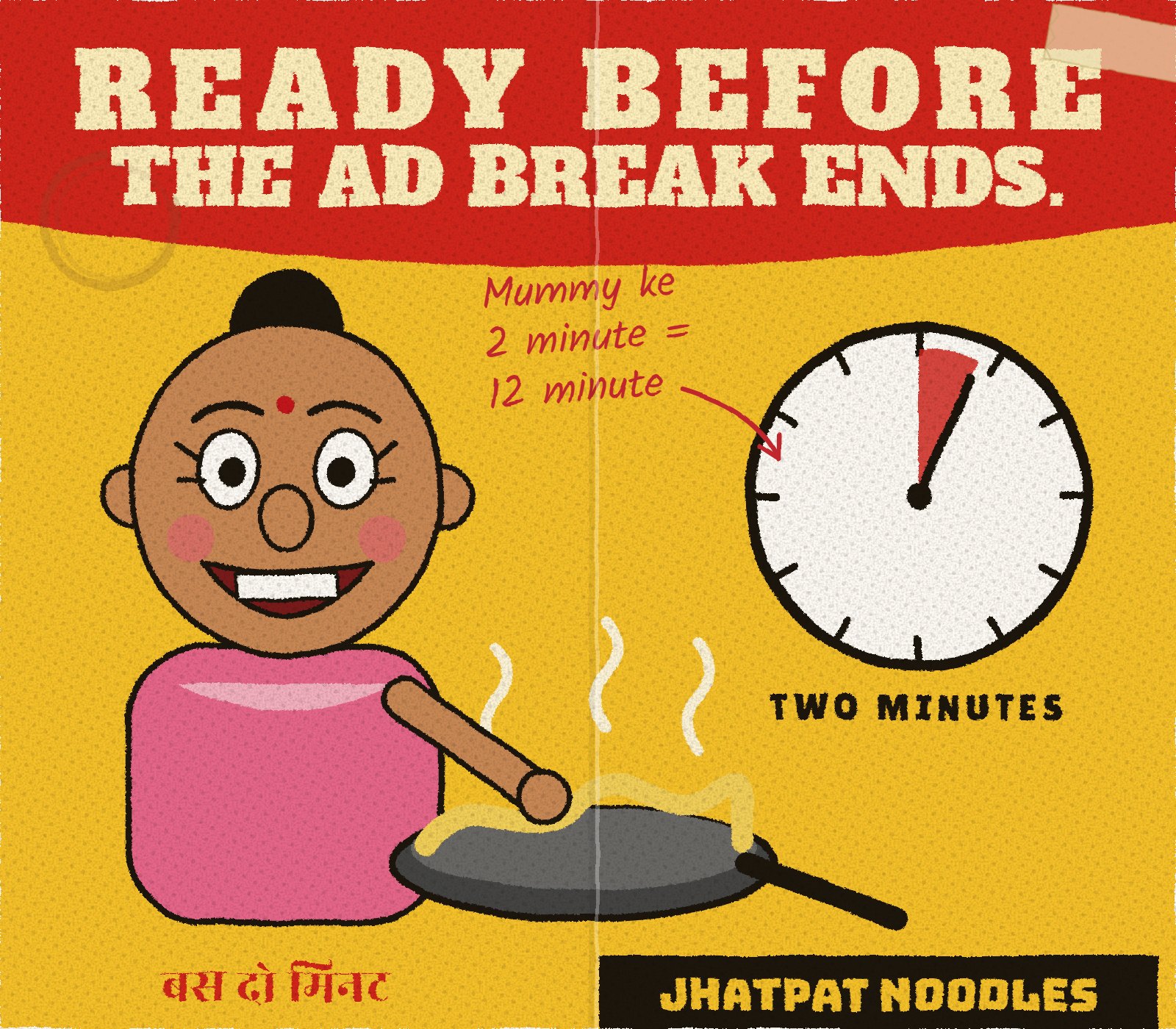
Take the 1980s piece in this series, a fictional noodle brand that promises to be “ready before the ad break ends”.
- Who: a mother, watching television, in a household for whom a break is a unit of time.
- Promise: speed, said in the language of the viewer's own evening.
- Left out: cost, nutrition, and the fact that someone still has to cook it.
- Medium: a print ad borrowing the rhythm of television, which tells you television had become the clock of the house.
- Taken for granted: that the break exists, is short, and is shared.
In other words, the ad's most interesting claim is about the viewer's life, not the product. That is the reading Adorno and Horkheimer's critique invites and Williams's refines: look past the product to the world the ad assumes.
Using it on your own work
The same five questions applied to a current campaign are a cheap audit. They are the first page of an outside-in brand audit, and they explain why the brief is not the idea. The cultural history behind them is in the series hub, iconic Indian ads for the ages, and one of the clearest examples is the Amul hoardings.
Sources
- Advertising: The Magic System (Raymond Williams), New Left Review, 1960
- The Culture Industry: Enlightenment as Mass Deception (Adorno and Horkheimer), Marxists Internet Archive, 1944 text
Questions we get asked
How do you analyse an old advertisement?
Ask five questions: who is addressed, what is promised, what is left out, what the medium allowed, and what the ad takes for granted.
What is the magic system?
Raymond Williams's name for modern advertising, which he described as a highly organised system of magical inducements and satisfactions that obscures real choices.
What is pseudo-individuality?
Adorno and Horkheimer's term for small surface differences that make standardised products look individual.
Run the five questions on your campaigns
We apply this reading to your current and past campaigns and report what they assume about your audience.
Ask for a scoped auditWhat we do · How we produce it · Who we do it for · Talk to us